Explore the technical distinctions between predictive and prescriptive analytics—algorithms, use cases, data requirements, and how they drive better decisions.
Introduction
In the data analytics pipeline, businesses seek not just to understand the past, but to anticipate the future and guide decisions. That’s where predictive and prescriptive analytics come into play.
Though often used interchangeably, they serve very different purposes and require different techniques. In this post, we’ll dive into the technical foundations of both, comparing algorithms, architectures, and applications.
1. What Is Predictive Analytics?
Goal: Forecast future outcomes based on historical data.
Output: Probabilistic estimates or trends.
Techniques Used:
- Supervised machine learning
- Regression (Linear, Ridge, Lasso)
- Classification (Logistic Regression, Random Forest, XGBoost)
- Time series forecasting
- ARIMA, Prophet, LSTM
Data Requirements:
- Labeled historical data
- Features engineered from structured or semi-structured sources
Examples:
- Predicting customer churn
- Sales forecasting
- Credit scoring
# Example: Predicting house prices
from sklearn.linear_model import LinearRegression
model = LinearRegression()
model.fit(X_train, y_train)
predictions = model.predict(X_test)
2. What Is Prescriptive Analytics?
Goal: Recommend optimal actions based on predictive outcomes.
Output: Actionable strategies or decisions.
Techniques Used:
- Optimization algorithms
- Linear/Integer Programming
- Genetic Algorithms
- Simulation modeling
- Monte Carlo simulations
- Decision theory
- Markov Decision Processes
- Reinforcement learning
- Q-learning, DDPG, PPO
Data Requirements:
- Predictive inputs + constraints + decision space
- Business rules or objective functions
Examples:
- Recommending product prices for maximum margin
- Optimizing delivery routes
- Allocating marketing budget across channels
# Example: Linear optimization with SciPy
from scipy.optimize import linprog
res = linprog(c=[-1, -2], A_ub=[[2, 1], [1, 1]], b_ub=[20, 16])
print(res.x)  # Optimal quantities
3. Comparison Table
| Feature | Predictive Analytics | Prescriptive Analytics |
|---|---|---|
| Primary Focus | Forecasting outcomes | Recommending actions |
| Techniques | Regression, ML, time series | Optimization, simulation, RL |
| Input | Historical data | Predictions + constraints |
| Output | Probabilities, trends | Best decisions under constraints |
| Common Tools | scikit-learn, XGBoost, Prophet | PuLP, Gurobi, AnyLogic, OpenAI Gym |
| Business Role | “What will happen?” | “What should we do?” |
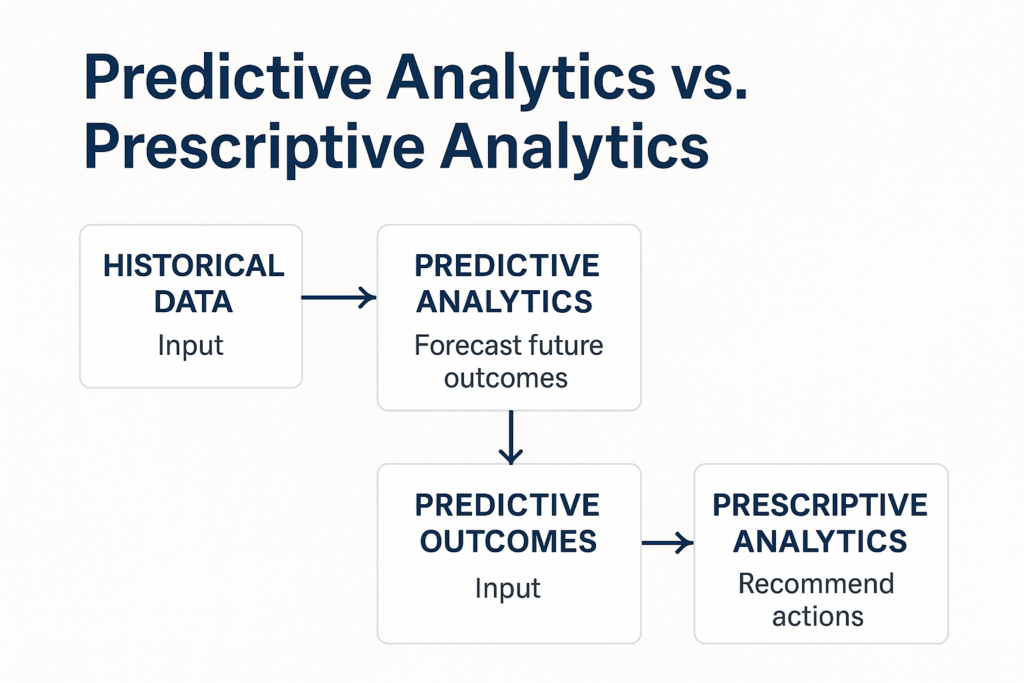
4. Integration in the Data Pipeline
- Descriptive Analytics → Summarizes past
- Diagnostic Analytics → Explains why it happened
- Predictive Analytics → Forecasts what’s next
- Prescriptive Analytics → Suggests what to do next
Often, predictive models are upstream to prescriptive systems:
- A demand forecast feeds into a supply chain optimization algorithm.
- A churn prediction informs retention campaign allocation.
5. Example Use Case: Retail Promotion
| Step | Tool/Model | Outcome |
|---|---|---|
| Predict sales uplift | XGBoost regression | Expected lift per promotion |
| Optimize promotion mix | Integer programming | Maximize revenue under budget constraints |
6. Challenges and Considerations
- Data Quality: Predictive models are sensitive to noise; prescriptive models depend on accurate constraints.
- Complexity: Prescriptive analytics typically requires deeper domain modeling.
- Computation: Optimization problems may be NP-hard, requiring approximation or heuristics.
- Interpretability: Predictions can be visualized; prescriptive decisions may need scenario explanations.
Conclusion
While predictive analytics gives us foresight, prescriptive analytics empowers us to act. They are complementary, not competitive. As organizations evolve their data maturity, mastering both is crucial for automated, intelligent decision-making.
Next Steps:
- Implement a basic forecast + optimization model in Python.
- Explore decision intelligence platforms like Gurobi, CPLEX, or Azure ML.
- Combine ML predictions with RL for adaptive business strategies.